
Learn how total participation techniques can transform your classroom by ensuring every student is actively engaged and thinking critically during every lesson.
Table of Contents
- What Are Total Participation Techniques?
- Why TPTs Matter for Student Engagement
- Practical Examples of TPTs
- Implementing TPTs in Your Classroom
- FAQ
- Comparison: TPT Approaches
- Practical Tips for TPTs
- Final Thoughts on Total Participation Techniques
- Useful Resources
Article Snapshot: Total participation techniques are teaching methods that give teachers evidence of active participation and cognitive engagement from all students at the same time. This guide covers what TPTs are, why they work, practical examples, and how to implement them effectively in any classroom setting.
Quick Stats: Total Participation Techniques

What Are Total Participation Techniques?
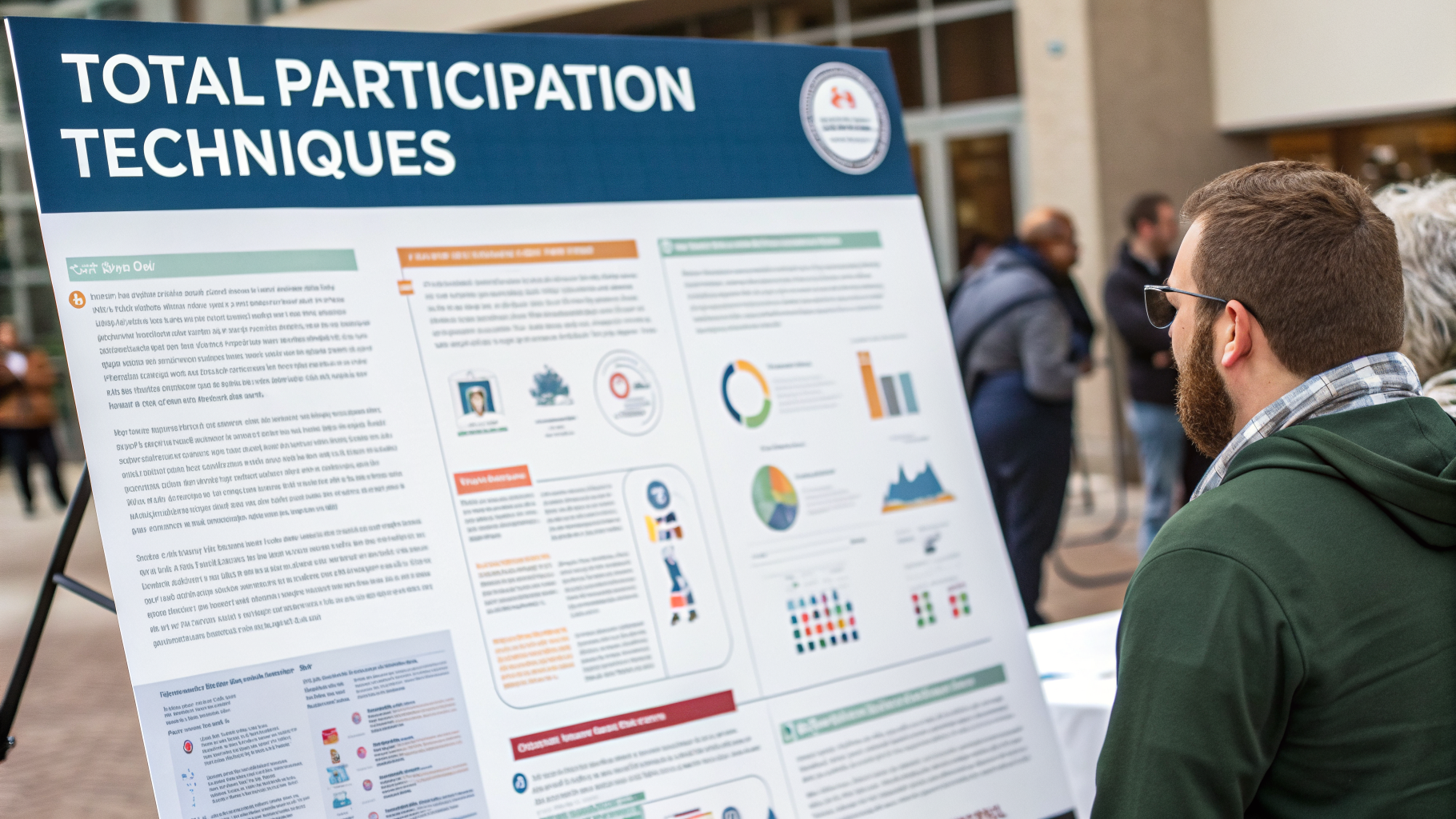
Total participation techniques, often abbreviated as TPTs, are structured teaching strategies designed to ensure that every student in the classroom is actively involved in the learning process. According to co-author Pérsida Himmele, a total participation technique is a teaching technique that allows a teacher to get evidence of active participation and cognitive engagement from all students at the same time (Atlas, 2024)[2]. This is a fundamental shift from traditional methods where only a few students raise their hands while the rest remain passive observers.
TPTs are built on the principle that engagement must be both visible and measurable. They move beyond simple participation, such as nodding along, to require students to demonstrate their thinking. Himmele explains that these techniques are ways to get evidence that every single student is with you at the same time and ensure they’re using higher-order thinking (Truth for Teachers, 2024)[3]. This dual focus on participation and cognitive depth is what makes TPTs uniquely effective.
The concept was popularized by educators Pérsida Himmele and William Himmele in their book, which now includes 51 classroom-tested alternatives to stand-and-deliver teaching (T/TAC Online, 2024)[1]. These techniques are not just theoretical; they are practical tools that have been refined through real classroom use. The third edition of the book is published by ASCD and serves as a comprehensive guide for educators looking to implement these strategies (ASCD, 2024)[4].
At their core, TPTs are about equity and accountability. They ensure that every student, regardless of their confidence level or learning style, has an opportunity to process information and contribute. This is particularly important in diverse classrooms where students may have different levels of prior knowledge. By using TPTs, teachers can quickly gauge understanding and adjust instruction in real time, making lessons more responsive and inclusive.
Key Components of TPTs
Effective TPTs share several common characteristics. First, they require a simultaneous response from all students, which prevents any single student from dominating the discussion. Second, they involve a cognitive task that goes beyond simple recall, encouraging students to analyze, synthesize, or evaluate information. Third, they provide the teacher with immediate feedback on student understanding, allowing for timely interventions. These components work together to create a classroom environment where active learning is the norm, not the exception.
Why TPTs Matter for Student Engagement
Student engagement is a critical factor in academic success, yet many traditional teaching methods fail to achieve it consistently. Total participation techniques directly address this problem by making engagement a requirement rather than an option. When every student must respond, the classroom dynamic shifts from a passive listening environment to an active thinking community. This is not just about keeping students busy; it is about deepening their understanding of the material.
Research in educational psychology supports the idea that active learning leads to better retention and comprehension. When students are required to process information and articulate their thoughts, they are more likely to remember the content and apply it in new contexts. TPTs facilitate this by providing structured opportunities for students to engage with the material in meaningful ways. For example, a technique like Chalkboard Splash asks students to summarize a key idea in 15 words or less, forcing them to distill complex information into its essential elements (Truth for Teachers, 2024)[3].
Furthermore, TPTs promote a growth mindset by normalizing the process of making thinking visible. When students share their ideas through techniques like Quick Writes or Think-Pair-Share, they learn that their contributions are valued and that making mistakes is part of the learning process. This can be particularly beneficial for students who are hesitant to speak up in class. By providing multiple ways to participate, TPTs help build confidence and foster a positive classroom culture.
From a teacher’s perspective, TPTs offer invaluable formative assessment data. Instead of relying on a few raised hands to gauge understanding, teachers can scan the room and see evidence of learning from every student. This allows for more targeted instruction and ensures that no student is left behind. As noted by the Himmele team, the goal is to get evidence that every single student is with you at the same time (Truth for Teachers, 2024)[3]. This real-time feedback loop is one of the most powerful aspects of using TPTs in the classroom.
Practical Examples of TPTs
There are many total participation techniques that teachers can use across different subjects and grade levels. The book by Himmele and Himmele details 51 such techniques, but a few stand out for their versatility and ease of implementation. One popular example is the Chalkboard Splash, where students write a short response to a prompt on the board simultaneously. This technique works well as a lesson opener or as a quick check for understanding. Himmele explains that students take that big idea and put it in their own words, 15 words or less (Truth for Teachers, 2024)[3]. This constraint encourages concise thinking and makes it easy for teachers to scan responses quickly.
Another effective technique is the Quick Write, where students write for a set amount of time on a specific topic. This can be used at any point in a lesson to help students organize their thoughts or reflect on what they have learned. Quick Writes are particularly useful for building writing fluency and helping students develop their own ideas before sharing them with a partner or the whole class. The key is that every student writes, so the teacher gets a complete picture of the class’s understanding.
A third technique, the Feature Walk, is ideal for texts with rich visual elements. William Himmele suggests that when you find yourself with a text that has a lot of features, pictures, diagrams, maps, charts, tables, etc., that text would be an ideal chapter to use for a feature walk (Atlas, 2024)[2]. In a Feature Walk, students move around the room to examine different features of a text or display, recording observations and questions. This kinesthetic activity keeps students engaged while building background knowledge before a reading or discussion.
Finally, the Pick-a-Card technique helps teachers randomly pair or group students. Himmele notes that this gives you a quick and easy way to pair kids up with people they’re comfortable with, because they’ve chosen these 12 people (Truth for Teachers, 2024)[3]. This approach reduces anxiety around partner work and ensures that students interact with a variety of classmates over time. These examples illustrate how TPTs can be adapted to different learning objectives and classroom settings.
Implementing TPTs in Your Classroom
Implementing total participation techniques effectively requires careful planning and a willingness to shift from a teacher-centered to a student-centered approach. The first step is to choose techniques that align with your learning objectives and the needs of your students. Start with one or two techniques and practice them until they become routine. For instance, you might begin with Quick Writes and Chalkboard Splash, as they are simple to introduce and require minimal materials. Once students are comfortable with these, you can gradually introduce more complex techniques like Feature Walks or Socratic Seminars.
It is also important to establish clear expectations for participation. Explain to students why you are using these techniques and how they benefit their learning. When students understand the purpose behind the activity, they are more likely to engage meaningfully. You can find a comprehensive guide to TPTs and their implementation on SuperLewis’s teaching strategies page, which offers practical advice for educators at all levels.
Another key aspect of implementation is the physical setup of your classroom. Some TPTs, like the Feature Walk, require space for students to move around. Others, like the Chalkboard Splash, require easy access to writing surfaces. Consider how your classroom layout can support these activities. You might also need to gather materials such as whiteboards, markers, or chart paper. The goal is to create an environment where TPTs can be used seamlessly without disrupting the flow of the lesson.
Finally, reflect on your practice and gather feedback from students. Ask them which techniques they find most engaging and why. Use this information to refine your approach and introduce new techniques over time. The ASCD book on total participation techniques provides a wealth of ideas and is a valuable resource for teachers looking to deepen their practice (ASCD, 2024)[4]. For more insights on student engagement, explore the classroom management resources available on SuperLewis.
Important Questions About Total Participation Techniques
What is the main goal of total participation techniques?
The main goal of total participation techniques is to ensure that every student in the classroom is actively participating and thinking critically at the same time. Unlike traditional methods that may only involve a few students, TPTs require a simultaneous response from all learners. This provides the teacher with immediate evidence of engagement and understanding, allowing for real-time adjustments to instruction. The techniques are designed to promote equity, accountability, and deeper cognitive processing.
How do TPTs differ from regular student participation?
Regular student participation often involves a few students raising their hands to answer questions, while the rest of the class remains passive. Total participation techniques, in contrast, require every student to respond simultaneously. This could be through writing, drawing, moving, or speaking in pairs. The key difference is that TPTs make participation visible and measurable for all students, not just the most vocal ones. This ensures that no student is overlooked and that the teacher has a complete picture of class understanding.
Can total participation techniques be used in any subject?
Yes, total participation techniques are highly versatile and can be adapted for any subject area, from mathematics and science to language arts and social studies. The core principles of TPTs – simultaneous response, cognitive engagement, and visible thinking – apply across disciplines. For example, a Chalkboard Splash can be used to summarize a historical event, solve a math problem, or explain a scientific concept. The key is to choose or adapt a technique that aligns with your specific learning objectives and the nature of the content.
What are some common challenges when implementing TPTs?
Common challenges include managing time effectively, ensuring all students are on task, and adapting techniques for different class sizes. Teachers may also find it difficult to transition from a lecture-based format to a more interactive one. However, these challenges can be overcome with practice and planning. Starting with simple techniques, setting clear expectations, and gradually introducing more complex activities can help. Additionally, many resources, including the book by Himmele and Himmele, offer practical tips for overcoming these hurdles.
Comparison: TPT Approaches
Different total participation techniques serve different purposes in the classroom. The table below compares four common approaches based on their primary goal, required materials, and best use case. Understanding these differences can help you select the right technique for your lesson.
| Technique | Primary Goal | Materials Needed | Best Use Case |
|---|---|---|---|
| Chalkboard Splash | Quick summarization | Whiteboard or chart paper | Lesson opener or closure |
| Quick Write | Individual reflection | Paper and pen | Mid-lesson check-in |
| Feature Walk | Building background knowledge | Text with visual features | Pre-reading activity |
| Think-Pair-Share | Collaborative discussion | None | Concept exploration |
Practical Tips for TPTs
To get the most out of total participation techniques, consider the following actionable tips. First, start small and build momentum. Introduce one technique at a time and practice it until it becomes a natural part of your classroom routine. This reduces overwhelm for both you and your students. Second, always have a clear purpose for each technique. Ask yourself what cognitive skill you want students to practice and how the technique will help you gather evidence of learning.
Third, use a variety of techniques to keep students engaged and to address different learning styles. Some students may excel at writing, while others prefer drawing or speaking. By rotating through techniques like Chalkboard Splash, Quick Writes, and Feature Walks, you can reach all learners. Fourth, create a safe environment for participation. Emphasize that all responses are valuable and that making mistakes is part of the learning process. This encourages students to take risks and share their thinking.
Fifth, use the data you collect from TPTs to inform your instruction. If you notice that many students are struggling with a concept, take time to reteach it. If most students demonstrate understanding, you can move on to more challenging material. This responsive teaching approach is one of the greatest benefits of using TPTs. Finally, collaborate with colleagues to share ideas and reflect on your practice. Many schools have professional learning communities where teachers can discuss effective strategies.
Final Thoughts on Total Participation Techniques
Total participation techniques offer a powerful way to transform your classroom into an active learning environment where every student is engaged and thinking critically. By implementing these strategies, you can gather real-time evidence of student understanding, promote equity, and foster a deeper love of learning. The techniques are backed by research and have been tested in classrooms across the globe. Start with one technique today and see the difference it makes. For more resources and ideas, explore the teaching guides available on SuperLewis to continue your professional growth.
Useful Resources
- T/TAC Online. Total Participation Techniques (TPT) Resource.
http://ttaconline.org/Resource/JWHaEa5BS75R39WIp9wRlQ/Resource-total-participation-techniques-tpt-persida-himmele–william-himmele - Atlas. Using Total Participation Techniques in the Classroom.
https://www.onatlas.com/blog/total-participation-techniques - Truth for Teachers. 5 total participation techniques to make every student an active learner.
https://truthforteachers.com/truth-for-teachers-podcast/total-participation-techniques/ - ASCD. Total Participation Techniques, 3rd Edition.
https://www.ascd.org/books/total-participation-techniques-3rd-edition?variant=125031
For more about Therapeutic laughter techniques and practices, see Therapeutic Laughter Techniques And Practices.