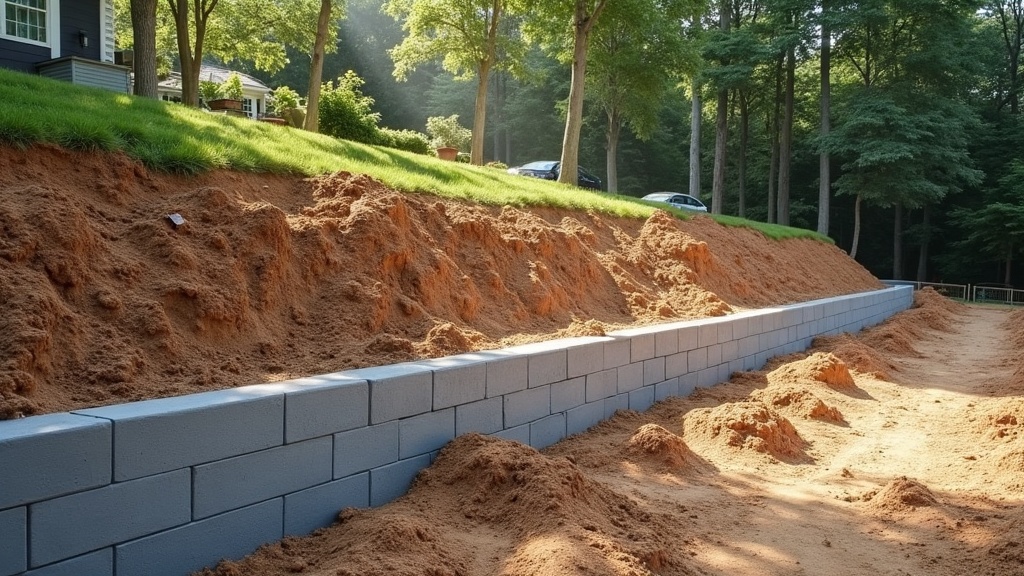
Learn how proper retaining wall backfill prevents failure and extends wall life. Expert advice on materials, drainage, compaction, and common mistakes to avoid for lasting structural stability.
Table of Contents
- Backfill Materials and Specifications
- Drainage and Hydrostatic Pressure Control
- Compaction Techniques and Lift Thickness
- Common Mistakes and How to Avoid Them
- Frequently Asked Questions
- Comparison: Gravel vs. Native Soil Backfill
- Practical Tips for Lasting Results
- Final Thoughts on Retaining Wall Backfill
Article Snapshot: Retaining wall backfill is the engineered material placed behind a retaining wall to provide drainage and reduce lateral earth pressure. Proper backfill selection, compaction in thin lifts, and integration of drainage systems are critical to preventing wall movement and failure. This guide covers material specifications, drainage best practices, compaction techniques, and common errors to ensure long-term wall performance.
Quick Stats: Retaining Wall Backfill
- Drainage zone of at least 12 inches of clean granular material directly behind the wall reduces hydrostatic pressure (Landscaping Network, 2024)[1].
- Backfill compaction should be carried out in lifts no thicker than 8 inches to achieve uniform density (Allan Block, 2024)[2].
- Compacted backfill should slope away from the wall at 2–5 percent to prevent water ponding (Big Home Projects, 2025)[3].
Retaining wall backfill is one of the most overlooked yet critical components of any retaining wall project. While many focus on the visible facing blocks or the structural design of the wall itself, the material placed behind the wall – and how it is installed – determines whether the wall will stand for decades or fail within a few years. As Dr. David T. Williams, a civil engineer specializing in hydraulics and retaining structures, noted in 2025, “The most common cause of retaining wall failure is not structural inadequacy of the wall itself, but improper backfill and drainage behind it.”[4] This article provides a comprehensive overview of retaining wall backfill materials, drainage requirements, compaction methods, and common pitfalls, helping homeowners, contractors, and engineers achieve stable, long-lasting results.
Backfill Materials and Specifications
The choice of backfill material is the single most important decision in retaining wall construction. Retaining wall backfill should consist of free-draining granular material placed in thin lifts and compacted, with a properly graded drainage layer immediately behind the wall to reduce pore water pressures (Dr. Robert L. Parsons, 2025)[5]. Clean gravel, crushed stone, or coarse sand are the preferred materials because they allow water to flow through freely rather than building up behind the wall. The drainage zone, typically a minimum of 12 inches wide, must be composed entirely of clean coarse aggregate rather than native soil (Villa Landscapes, 2025)[6]. This zone acts as a pressure relief system, channeling water down to a perforated drain pipe at the base of the wall. For the backfill zone beyond the drainage layer, select granular fill with low fines content – less than 5–10 percent passing the #200 sieve – to maintain permeability. Avoid using clay, silt, or any cohesive soil that retains water, as these materials generate high hydrostatic pressure when saturated. Dr. Dov Leshchinsky emphasized in 2025 that “backfill material with low fines content, combined with a drainage system at the heel of the wall, greatly reduces lateral earth pressures and improves the reliability of retaining structures.”[7]
Drainage and Hydrostatic Pressure Control
Effective drainage is non-negotiable for any retaining wall that will experience rainfall or groundwater. Retaining wall backfill must be paired with a drainage system that collects and diverts water away from the wall structure. The standard approach involves installing a perforated drain pipe at the base of the wall, surrounded by clean gravel, with a slope of approximately 1/8 inch per foot to convey water out of the backfill zone (How to Hardscape, 2025)[8]. This pipe should outlet to daylight, a storm drain, or a splash pad located away from the wall’s foundation. The granular drainage zone should extend the full height of the wall, and a geotextile fabric is often placed between the drainage aggregate and the native soil to prevent fines from migrating into the gravel and clogging the system. Professor Richard J. Bathurst noted in 2025 that “experience from thousands of reinforced and unreinforced retaining walls shows that effective drainage and appropriate backfill selection are far more critical to performance than the facing system used.”[9]
Compaction Techniques and Lift Thickness
Proper compaction of retaining wall backfill is essential to prevent settlement and wall movement. The backfill must be placed in thin, uniform lifts and compacted to at least 95 percent of standard Proctor density to minimize post-construction settlement and improve wall stability (Tidy Home Guide, 2025)[10]. For granular backfill, lifts should not exceed 8 inches in loose thickness (Allan Block, 2024)[2], while for soil backfill, lifts should be limited to 4–6 inches before compaction (Constructli, 2026)[11]. Use a plate compactor or vibratory roller for granular materials, taking care not to over-compact near the wall face to avoid damaging the wall structure. Each lift should be compacted with a minimum of two to three passes, and the surface should be lightly moistened if the material is dry to improve compaction efficiency. The compacted backfill surface should slope away from the wall at 2–5 percent to prevent water from ponding behind the wall (Big Home Projects, 2025)[3]. Dr. John K. Mitchell summarized the importance of this process in 2025: “The backfill zone behind a retaining wall should be treated as an engineered soil system, where drainage, compaction, and material gradation are carefully controlled to limit deformations and reduce the risk of instability.”[12]
Common Mistakes and How to Avoid Them
Even experienced builders can make errors with retaining wall backfill that compromise the wall’s longevity. The most frequent mistakes include using native soil as backfill, failing to install a drainage system, compacting in lifts that are too thick, and neglecting to slope the backfill surface. Using clay or silty soil directly behind the wall is a recipe for disaster – these materials retain water, swell, and generate enormous lateral pressure that can push the wall forward or cause it to crack. Another common error is omitting the perforated drain pipe at the base, which forces water to accumulate behind the wall rather than being evacuated. Compacting lifts thicker than 8 inches for granular material or 6 inches for soil leads to uneven density and eventual settlement, which can cause the wall to tilt or the backfill to sink. Finally, failing to slope the backfill surface away from the wall allows rainwater to pool directly behind the wall, saturating the backfill and increasing hydrostatic pressure. To avoid these issues, always use clean granular material for the drainage zone, install a properly sloped drain pipe, compact in thin lifts, and grade the backfill surface to shed water away from the wall. For resources on proper installation, consider reviewing a backfill retaining wall with gravel guide for step-by-step instructions.
Important Questions About Retaining Wall Backfill
What is the best material for retaining wall backfill?
The best material for retaining wall backfill is clean, free-draining granular aggregate such as crushed stone, gravel, or coarse sand. The drainage zone immediately behind the wall should consist entirely of clean coarse aggregate – typically 3/4-inch to 1.5-inch washed stone – to allow water to flow freely downward to the drain pipe. For the backfill zone beyond the drainage layer, select a granular fill with low fines content (less than 5–10 percent passing the #200 sieve). Avoid clay, silt, or any soil that retains water, as these materials generate high hydrostatic pressure when saturated and can cause wall failure.
How thick should the gravel drainage zone be behind a retaining wall?
The gravel drainage zone behind a retaining wall should be at least 12 inches wide for the full height of the wall. This 12-inch minimum width ensures adequate capacity to collect and convey water down to the perforated drain pipe at the base of the wall. For walls taller than 4 feet or in areas with heavy rainfall, a wider drainage zone of 18–24 inches may be recommended to provide additional water storage and flow capacity. The drainage zone must be composed of clean coarse aggregate, not native soil, to function effectively.
How do you compact backfill behind a retaining wall?
Compaction of retaining wall backfill should be done in thin lifts. For granular backfill, lifts should not exceed 8 inches in loose thickness. For soil backfill, lifts should be limited to 4–6 inches. Each lift should be compacted using a plate compactor or vibratory roller, with a minimum of two to three passes per lift. The target density is at least 95 percent of standard Proctor density. Avoid over-compacting near the wall face to prevent damage. The surface of each lift should be lightly moistened if the material is dry to improve compaction efficiency.
Do you need a drain pipe at the base of a retaining wall?
Yes, a perforated drain pipe at the base of the retaining wall is essential for most installations. The drain pipe, typically 4-inch diameter PVC or corrugated pipe, should be installed at the bottom of the drainage zone with a slope of approximately 1/8 inch per foot to convey water out of the backfill. The pipe must outlet to daylight, a storm drain, or a splash pad located away from the wall’s foundation. Without a drain pipe, water accumulates behind the wall, increasing hydrostatic pressure and significantly raising the risk of wall failure.
Comparison: Gravel vs. Native Soil Backfill
Choosing between gravel backfill and native soil is one of the most consequential decisions in retaining wall construction. While native soil may seem convenient and cost-free, its use directly behind the wall introduces significant risks. The table below compares the two approaches across key performance factors.
| Factor | Clean Gravel Backfill | Native Soil Backfill |
|---|---|---|
| Drainage capability | Excellent; high permeability allows water to flow through | Poor; clay and silt retain water, increasing hydrostatic pressure |
| Lateral earth pressure | Low; well-drained gravel exerts minimal pressure | High; saturated soil can double or triple lateral loads |
| Compaction difficulty | Moderate; requires proper lift thickness and equipment | Difficult; moisture-sensitive and prone to uneven compaction |
| Settlement risk | Low when properly compacted | High; organic content and moisture changes cause settlement |
| Cost | Higher material cost; lower long-term risk | Low initial cost; high potential for repair or replacement |
In almost all cases, clean gravel or crushed stone backfill is the superior choice for retaining wall backfill. The small additional material cost is far outweighed by the long-term reliability and reduced risk of wall failure. For those seeking advanced solutions, backfill grouting techniques for mining applications offer specialized methods for stabilizing backfill in demanding environments.
Practical Tips for Lasting Results
To ensure your retaining wall backfill performs as intended, follow these actionable recommendations. First, always install a geotextile fabric between the drainage aggregate and the native soil to prevent fines from migrating into the gravel and clogging the system. Second, use a perforated drain pipe with a minimum 4-inch diameter, wrapped in a filter sock, and slope it at 1/8 inch per foot toward an outlet. Third, compact the backfill in lifts no thicker than 8 inches for granular material or 6 inches for soil, and verify compaction with a nuclear density gauge or sand cone test when possible. Fourth, grade the finished backfill surface to slope away from the wall at 2–5 percent to shed rainwater. Fifth, consider using a drainage board or prefabricated drainage composite on the back of the wall for additional water management. Finally, if the wall is taller than 4 feet or supports a surcharge load (such as a driveway or building), consult a geotechnical engineer for site-specific recommendations. For operators and contractors seeking specialized training, CDL training near me can help ensure that heavy equipment operators are properly certified for backfill compaction work.
Final Thoughts on Retaining Wall Backfill
Retaining wall backfill is far more than just dirt behind a wall – it is an engineered system that determines the wall’s long-term stability and safety. By selecting clean granular materials, installing a proper drainage system, compacting in thin lifts, and avoiding common mistakes, you can significantly extend the life of your retaining wall and prevent costly failures. Whether you are a homeowner building a garden wall or a contractor working on a commercial project, prioritizing proper backfill practices is the most effective investment you can make. To learn more about advanced backfill solutions and structural support techniques, explore the resources available on Super Lewis for comprehensive guides and professional insights.
Useful Resources
- Retaining Wall Drainage Guide. Landscaping Network.
https://www.landscapingnetwork.com/walls/retaining.html - How to Backfill a Retaining Wall. Constructli.
https://constructli.com/how-to-backfill-a-retaining-wall/ - Retaining Wall Drainage Guide. Big Home Projects.
https://www.linkedin.com/posts/big-home-projects_two-to-five-percent-backfill-slope-drainfix-activity-7412895611504480256-erN4 - Design and Maintenance of Small Retaining Walls. Dr. David T. Williams.
https://www.fs.usda.gov/engineering/pdf/retaining-wall-design-guide-small-structures.pdf - Lateral Earth Pressures on Retaining Structures – Lecture Notes. Dr. Robert L. Parsons.
https://civil.ku.edu/sites/civil/files/documents/retaining-structures-backfill-drainage-parsons.pdf - Proper Backfilling & Drainage. Villa Landscapes.
https://villalandscapes.com/proper-backfilling-drainage-retaining-wall-collapse/ - Design of Reinforced Soil Retaining Walls – Key Considerations. Dr. Dov Leshchinsky.
https://www.researchgate.net/publication/Design_of_reinforced_soil_retaining_walls_Leshchinsky - Backfilling a Retaining Wall. How to Hardscape.
https://howtohardscape.com/backfilling-a-retaining-wall/ - Recent Advances in the Design and Performance of Retaining Walls. Prof. Richard J. Bathurst.
https://www.researchgate.net/publication/Recent_advances_design_performance_retaining_walls_Bathurst - Backfilling a Retaining Wall: Expert Guide. Tidy Home Guide.
https://tidyhomeguide.com/backfilling-a-retaining-wall-expert-guide/ - How to Backfill a Retaining Wall. Constructli.
https://constructli.com/how-to-backfill-a-retaining-wall/ - Mitigation of Retaining Wall Distress in Urban Environments. Dr. John K. Mitchell.
https://ce.berkeley.edu/~mitchell/retaining-walls-backfill-mitigation