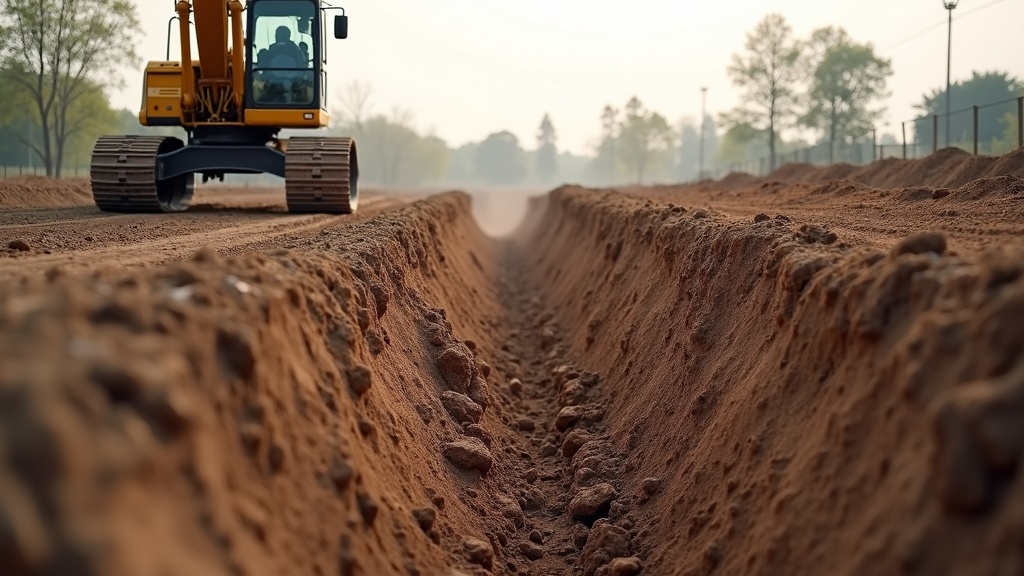
Learn how to backfill a trench correctly in mining environments. This guide covers lift thickness, compaction standards, material selection, and safety protocols to ensure stable and compliant trench backfill.
Table of Contents
- Article Snapshot
- Market Snapshot
- Introduction
- Understanding the Basics of Backfilling a Trench
- Lift Thickness and Compaction Requirements
- Material Selection for Durable Backfill
- Safety and Stability During Trench Backfill
- Your Most Common Questions
- Comparison of Backfill Methods
- Practical Tips for Effective Trench Backfill
- Key Takeaways
- Learn More
Article Snapshot
Backfilling a trench is the process of replacing and compacting excavated or imported material into an open excavation to restore ground stability. This article explains lift thickness, compaction requirements, and material choices for mining trench backfill, along with safety practices to prevent collapse and settlement.
Market Snapshot
- Maximum loose lift thickness for Type A trench backfill in Glendive, Montana: 8 inches (City of Glendive, 2024)[1]
- Trench backfill must be compacted to at least 95% of maximum dry density per AASHTO T99 or ASTM D698 (City of Glendive, 2024)[1]
- Minimum relative density for sand backfill in Mile High Flood District: 75% (Mile High Flood District, 2024)[2]
Introduction
When you backfill a trench in a mining operation, you are not simply dumping soil back into a hole. Proper backfilling requires careful planning, correct material selection, and precise compaction to prevent future settlement, utility damage, and safety hazards. This article covers the essential elements of trench backfill in mining contexts – from lift thickness standards to compaction specifications – and provides actionable guidance for achieving durable, compliant results. Whether you are backfilling after pipe installation or restoring a haul road trench, understanding the core principles will save time, reduce costs, and improve safety.
Understanding the Basics of Backfilling a Trench
To backfill a trench means to replace the excavated soil or bring in a better-suited material and compact it in layers to restore the ground to its original or better condition. In mining, trenches are often dug for utility lines, drainage, or foundation work, and the backfill must support heavy equipment and resist water infiltration. The process begins by placing the first lift of material – typically 6 to 12 inches deep – and compacting it before adding the next layer.
The Occupational Safety and Health Administration (OSHA) emphasizes that soil must be placed a minimum of 2 feet from the edge of the excavation to prevent materials from rolling back into the trench and to reduce the risk of trench wall collapse during backfilling (OSHA, 2024).[3] This guideline is critical in mining where trench walls can be unstable due to ground vibrations or moisture. Additionally, compaction efforts must start from the bottom and work upward, ensuring each lift reaches the required density before proceeding.
Why Controlled Lifts Matter
Dumping large volumes of fill and attempting to compact from the surface leads to voids and eventual settlement. The Metropolitan Government of Nashville and Davidson County specifies that backfill material shall be placed in uniform loose lifts not exceeding eight inches and each lift shall be compacted to at least 95 percent of maximum density to prevent settlement and pavement failure (Nashville Public Works, 2024).[4] For mining sites, this precision is even more critical because uneven settlement can disrupt haul roads and damage buried infrastructure.
Lift Thickness and Compaction Requirements
Compaction specifications for trench backfill vary by jurisdiction and soil type, but a common thread is the need for thin, uniform lifts. In Glendive, Montana, the maximum loose lift thickness for Type A trench backfill is 8 inches, and the material must be compacted to at least 95% of maximum dry density as determined by AASHTO T99 or ASTM D698.[1] Many mining contracts adopt similar standards to ensure long-term stability.
The Mile High Flood District requires most trench backfill to be compacted to 95% of Maximum Standard Proctor density, with a minimum relative density of 75% for sand backfill in cohesionless soils (Mile High Flood District, 2024).[2] In mining environments, where soils may be mixed with rock fragments, it is essential to perform field compaction tests (such as nuclear density gauge or sand cone) to verify compliance.
Compaction Equipment and Techniques
For trench backfill in confined spaces, plate compactors and rammers are commonly used. The first layer over pipes – often a selected backfill – should be placed in 6-inch lifts and hand-tamped or mechanically compacted to avoid damaging the pipe. Gulf Shores Utilities requires selected backfill around utility pipes to be placed in 6-inch layers to a depth of 12 inches over the top of the pipe, with subsequent layers limited to 9 inches before compaction (Gulf Shores Utilities, 2024).[5]
Material Selection for Durable Backfill
The material used to backfill a trench can make or break the integrity of the restored ground. Most specifications call for select backfill – granular material free of organic matter, large rocks, and debris. In mining, you might use crushed rock, sand, or a controlled low-strength material (CLSM) like flowable fill. The choice depends on the intended use of the trench area and the load it must bear.
Harris County Engineering Department advises that select backfill shall be placed in lifts not greater than six inches and compacted to a minimum of 95% of Standard Proctor density to ensure long-term stability of utility trenches within public right-of-way (Harris County Engineering, 2024).[6] This is directly applicable to mining utility corridors. For sites requiring additional support, geogrid reinforcement or cement-treated backfill can be used.
Avoiding Common Material Mistakes
Using the excavated spoil directly is often discouraged, especially when the soil contains clay, silt, or high moisture levels. These materials are difficult to compact and prone to settlement. If you must reuse on-site soil, consider mixing it with a granular additive or conditioning it to an optimal moisture content before placement. Melbourne Mini Diggers state that the key to a stable trench backfill is placing material in controlled layers and compacting each layer thoroughly, rather than dumping soil in one go and trying to compact it from the surface (Melbourne Mini Diggers, 2024).[7]
Safety and Stability During Trench Backfill
Safety remains paramount when you backfill a trench, especially in mining where heavy equipment operates nearby. Before backfilling begins, ensure the trench is free of standing water and that the walls are stable. OSHA’s requirement to keep spoil at least 2 feet from the edge continues to apply during backfilling operations to prevent additional load on the trench walls.[3]
Compaction equipment should be operated by trained personnel, and the area should be marked to avoid accidental entry by vehicles. Use of heavy vibratory rollers or plate compactors for compacting large areas requires careful coordination. Also, when backfilling near structures or existing utilities, consider using hand compaction methods to avoid damaging sensitive components. Regular testing – at least one compaction test per 500 square feet of fill – helps maintain quality control.
Finally, always backfill in layers that match the compaction equipment’s capacity. For example, a heavy vibratory roller can typically handle 12-inch lifts, while a hand tamper is limited to 4-6 inches. Adjust lift thickness accordingly to achieve specified density. For related applications in mining site stabilization, refer to additional resources on backfilling retaining walls with granular material.
Your Most Common Questions
What is the best material to backfill a trench in mining?
The best material for mining trench backfill is granular, free-draining material such as crushed rock, sand, or gravel with less than 10% fines. Flowable fill (controlled low-strength material) is also excellent for utility trenches requiring later excavation. Avoid highly plastic clays or organic soils, as they are difficult to compact and prone to settlement.
How thick should each lift be when backfilling a trench?
Most specifications call for loose lift thickness between 6 and 12 inches. For the initial backfill covering pipes, 6-inch lifts are standard. General trench backfill can use 8-inch lifts. Thicker lifts are rarely allowed because compaction equipment cannot achieve uniform density beyond that depth.
What compaction percentage is required for trench backfill?
Most municipal and mining specifications require compaction to at least 95% of maximum dry density (Standard Proctor). Some jurisdictions require 95% to 98% depending on the surface load. For sand and gravel backfill, relative density of 75% is often the minimum. Field density tests should be performed to verify compliance.
How can I prevent settlement after backfilling a trench?
Preventing settlement starts with proper lift thickness and compaction. Ensure each lift is compacted thoroughly before adding the next. Use appropriate compaction equipment for the trench width. Water tamping (jetting) is not recommended because it can create voids. For critical areas, consider using self-compacting backfill like flowable fill or performing re-compaction after initial settlement.
Comparison of Trench Backfill Methods
Choosing the right method to backfill a trench depends on site conditions, material availability, and performance requirements. The table below compares three common approaches used in mining and civil construction.
| Method | Typical Material | Lift Thickness | Compaction Requirement | Best For |
|---|---|---|---|---|
| Mechanical Compaction | Granular soil or crushed rock | 6–12 inches | 95% Standard Proctor | General trench backfill under roads and yards |
| Flowable Fill (CLSM) | Cementitious slurry | Full depth in one pour | Self-leveling, no compaction needed | Utility trenches requiring future excavation |
| Water Settling (Jetting) | Sand or fine gravel | 2–4 feet per lift | Relies on water to settle particles | Non-critical fills where settlement is acceptable |
Practical Tips for Effective Trench Backfill
Implementing these tips will help you backfill a trench efficiently and achieve long-lasting stability.
- Test moisture content: Before compaction, ensure the fill material is at or near optimum moisture content. Too dry and particles won’t bond; too wet and the soil becomes unstable. Use a moisture-density gauge to verify.
- Use selected backfill around pipes: Place a 12-inch layer of fine granular material over the pipe before adding general backfill. This prevents sharp rocks from damaging the pipe and provides uniform support.
- Perform compaction tests early: After the first few lifts, run a density test to confirm your equipment and lift thickness are achieving the required compaction. Adjust if necessary before covering more area.
Key Takeaways
Mastering how to backfill a trench in mining operations requires attention to three elements: correct lift thickness, proper compaction, and suitable material. Following regulatory standards such as those from OSHA, the City of Glendive, and the Mile High Flood District ensures both safety and long-term performance. For projects that require expert mining backfill grouting solutions, professional services can provide site-specific guidance and advanced techniques. Explore SEO strategies for the mining industry to improve the online visibility of your backfill services.
Learn More
- City of Glendive, Montana – Code of Ordinances.
https://codelibrary.amlegal.com/codes/glendivemt/latest/glendive_mt/0-0-0-3086 - Mile High Flood District – Section 31 23 33 Trenching and Backfilling.
https://www.mhfd.org/files/84d4f2e1b/31_23_33_Trenching_and_Backfilling.pdf - Occupational Safety and Health Administration – Trenching and Excavation Safety.
https://www.osha.gov/sites/default/files/publications/osha2226.pdf - Metropolitan Government of Nashville and Davidson County – Standard Specifications for Trenching, Backfilling and Compaction.
https://www.nashville.gov/sites/default/files/2024-04/Trenching_Backfilling_Compaction_Specs.pdf - Gulf Shores Utilities – Trenching, Backfilling and Compacting for Utility Systems.
https://www.gulfshoresutilities.com/specs1/ - Harris County Engineering Department – Utility Trench Backfill Specifications.
https://eng.hctx.net/sites/default/files/2024-02/Utility_Trench_Backfill_Standards.pdf - Melbourne Mini Diggers – Basic Requirements and Procedures of Backfilling Trenches.
https://melbourneminidiggers.com.au/basic-requirements-and-procedures-of-backfilling-trenches/