
Discover how cool math games combine logic puzzles with fun learning for kids, offering a playful way to build numeracy and reasoning skills without the pressure of traditional instruction.
Table of Contents
- What Are Cool Math Games?
- Educational Benefits of Game-Based Math Learning
- How to Use Cool Math Games in the Classroom
- Popular Game Titles and Categories on Coolmath Games
- Frequently Asked Questions
- Comparison: Coolmath Games vs. Traditional Math Drills
- Practical Tips for Parents and Teachers
- Key Takeaways
- Useful Resources
- First launched in 1997, making it one of the longest-running educational game websites (Wikipedia, 2025).
- Offers 200+ games and mini-games on its mobile app (Google Play Store, 2025).
- Covers kindergarten through sixth grade on its sister site, CoolMath4Kids (CoolMath4Kids, 2025).
- Features 4 main game categories: logic, math, strategy, and skill games (Coolmath Games, 2025).
What Are Cool Math Games?
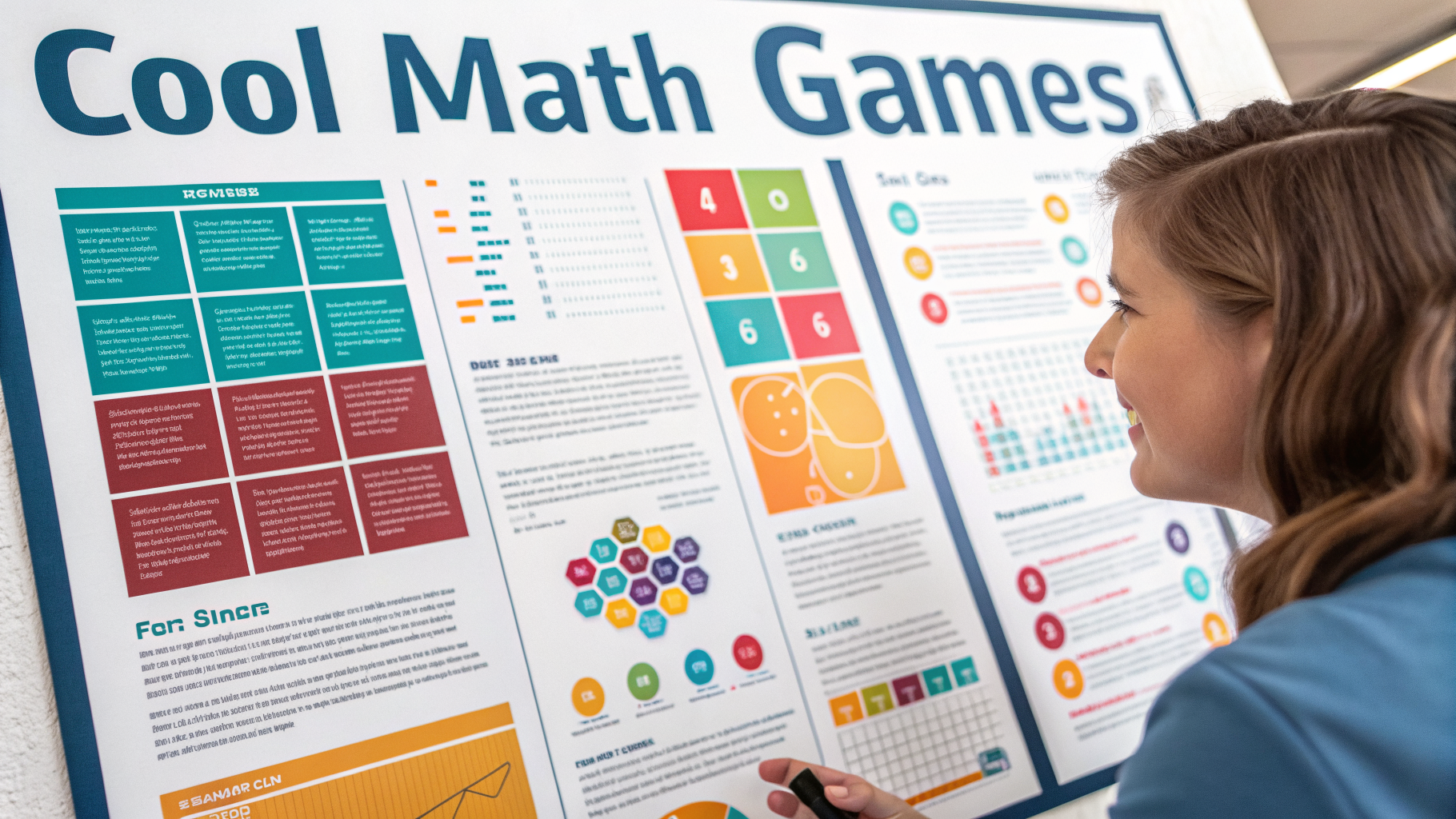
Cool math games are a collection of browser-based and mobile-friendly puzzles, logic challenges, and strategy activities hosted primarily on Coolmath Games. The platform, which has been online since 1997 (Wikipedia, 2025)[1], aims to make logic and problem-solving feel like play. As Mike McFarlane, CEO of Coolmath.com LLC, explains: “Our goal with Coolmath Games has always been to make logic and problem‑solving feel like play, so that kids are building real math and reasoning skills without the anxiety that often comes with traditional instruction” (Coolmath Games, 2025)[2].
Unlike many drill-based apps, these games embed mathematical thinking into engaging scenarios. Players might navigate a character through a maze using geometric reasoning, solve a logic grid puzzle, or plan a strategy to clear a board. The site categorizes its content into logic, math, strategy, and skill games, with over 200 titles available on its mobile app (Google Play Store, 2025)[3]. The sister site, CoolMath4Kids, targets kindergarten through sixth grade with lessons and games designed for younger learners (CoolMath4Kids, 2025)[4].
The platform has evolved significantly since its launch, adapting from Flash-based games to modern HTML5 and mobile app formats. This longevity speaks to its enduring appeal: it occupies a unique space where education meets entertainment, often described as a “third space” for learning between school and home. For parents and educators looking for engaging educational websites for children, Coolmath Games remains a top contender.
Educational Benefits of Game-Based Math Learning
Research consistently shows that game-based learning can improve student engagement and retention, particularly in mathematics. Professor Hendrik Drachsler of Goethe University Frankfurt notes that “digital games like Coolmath Games can provide a low‑pressure environment where learners repeatedly practice core numeracy and reasoning skills, which is essential for long‑term retention” (Springer, 2025)[5]. This repeated practice, delivered through fun challenges, helps solidify concepts that might otherwise feel abstract or intimidating.
Stanford Professor Jo Boaler adds that when students encounter mathematics through games and puzzles, “they start to see math as creative, visual and exploratory rather than a fixed set of rules” (youcubed.stanford.edu, 2024)[6]. This shift in mindset is crucial: students who view math as a creative endeavor are more likely to persist through difficult problems and develop a growth mindset. The low-stakes nature of games means failure is simply a prompt to try again, reducing anxiety and building resilience.
Furthermore, Professor Kurt Squire from UC Irvine observes that “browser‑based math and logic portals like Coolmath Games have become a kind of ‘third space’ for learning, sitting between school and home where kids willingly spend time working through complex problem‑solving challenges” (UCI, 2025)[7]. This voluntary engagement is a powerful educational tool – children are learning because they want to, not because they have to. The platform also supports differentiated learning, as students can choose games that match their skill level and interests, whether they are practicing basic arithmetic or tackling advanced logic puzzles.
How to Use Cool Math Games in the Classroom
Integrating cool math games into a classroom setting requires thoughtful planning to maximize educational value. Many teachers already use the platform as a reward or enrichment activity. Sarah Johnson, a middle school math teacher in Austin, Texas, shares: “I use Coolmath Games as a reward activity, but it’s a reward that still keeps students thinking – many of the logic and strategy games are more challenging than my regular warm‑ups” (EdWeek, 2025)[8]. This approach turns free time into productive learning without students feeling like they are doing extra work.
Teachers can also assign specific games that align with current curriculum topics. For example, a game that requires spatial reasoning can supplement a geometry unit, while logic puzzles can introduce concepts of conditional statements and problem decomposition. The platform’s categorization into logic, math, strategy, and skill games makes it easy to find appropriate content. Additionally, the mobile app version allows for use on school tablets or during computer lab time, offering flexibility in how technology is deployed in the classroom.
For schools looking to develop a comprehensive digital learning strategy, resources like AI training and curriculum integration guides for educators can provide additional frameworks. It is also important to set clear expectations: teachers should preview games to ensure they are age-appropriate and aligned with learning objectives, and they can create simple worksheets or discussion prompts to accompany gameplay. This ensures that the time spent on the platform is purposeful and connected to broader classroom goals.
Popular Game Titles and Categories on Coolmath Games
The Coolmath Games platform hosts hundreds of titles, but a few have become enduring favorites among students and teachers alike. The site’s main categories – logic, math, strategy, and skill – each offer distinct types of challenges. Logic games, for example, often involve deduction and pattern recognition, while strategy games require planning and resource management. Skill games focus on hand-eye coordination but still incorporate elements of timing and spatial awareness.
Classic titles include Run (a fast-paced platformer that requires quick thinking and route planning), Fireboy and Watergirl (a cooperative puzzle game that teaches teamwork and problem-solving), and Papa’s Freezeria (a time-management game that involves sequencing and resource allocation). These games are popular because they are fun first and educational second – students are drawn to the gameplay and absorb the underlying skills almost incidentally.
The platform also regularly updates its library, adding new games that reflect current trends in gaming and education. The mobile app, which includes hundreds of games, ensures that the experience is accessible on the go. For those interested in the science behind game-based learning, an external resource on game-based learning research findings offers further insights. The variety of content means there is something for nearly every age group and skill level, from simple counting games for kindergarteners to complex logic puzzles that challenge adults.
Frequently Asked Questions
Are cool math games free to play?
Yes, the vast majority of games on Coolmath Games are free to play in a web browser. The site is ad-supported, which allows it to offer content without a subscription fee. There is also a mobile app available on Google Play that is free to download, though it may contain in-app purchases or advertisements. The free model makes the platform accessible to a wide range of students, regardless of their family’s budget.
What age group is Coolmath Games designed for?
Coolmath Games is primarily designed for children in elementary through middle school, roughly ages 6 to 14. The sister site CoolMath4Kids specifically targets kindergarten through sixth grade with simpler lessons and games. However, many of the logic and strategy games on the main site are challenging enough to engage high school students and even adults. The platform’s broad appeal lies in its focus on thinking skills rather than age-specific content.
Do cool math games actually teach math skills?
Yes, but not always in a direct, drill-based way. Many games teach underlying mathematical thinking, such as logic, pattern recognition, spatial reasoning, and strategic planning. These are foundational skills for higher-level math. Some games explicitly involve arithmetic or geometry, while others require players to apply mathematical concepts indirectly. Research from experts like Professor Hendrik Drachsler supports the idea that repeated practice through games improves numeracy and reasoning skills over time.
Is Coolmath Games safe for children to use?
Coolmath Games is widely considered safe for children. The site is designed to be classroom-friendly and does not feature violent or inappropriate content. It is ad-supported, but the ads are generally family-safe. However, as with any online platform, parental supervision is recommended. Teachers and parents should preview games to ensure they align with their values and educational goals. The platform also does not require users to create accounts to play, which limits data collection and privacy concerns.
Comparison: Coolmath Games vs. Traditional Math Drills
Both cool math games and traditional math drills aim to build mathematical skills, but they take very different approaches. The table below highlights key differences to help educators and parents choose the right tool for their needs.
| Feature | Coolmath Games | Traditional Math Drills |
|---|---|---|
| Engagement Style | Playful, exploratory, voluntary | Repetitive, structured, often mandatory |
| Skill Focus | Logic, reasoning, strategy, problem-solving | Fact recall, procedural fluency |
| Error Handling | Low-stakes, encourages retrying | Can feel punitive, emphasizes correctness |
| Content Variety | Hundreds of games across multiple categories | Typically limited to worksheets or flashcards |
| Best For | Building conceptual understanding and love for math | Mastering basic facts and procedures |
Both approaches have their place. Drills are effective for building automaticity with basic facts, while games excel at fostering deeper understanding and a positive attitude toward mathematics. A balanced approach that uses both can be highly effective.
Practical Tips for Parents and Teachers
Getting the most out of cool math games requires intentional use. Here are actionable tips for parents and teachers looking to integrate these games into learning routines:
- Set time limits. While the games are educational, screen time should still be balanced. A 15- to 20-minute session can be a productive break or reward without becoming a distraction.
- Discuss the strategy. After playing, ask children what strategies they used. This reinforces the thinking process and helps transfer skills to other contexts. Questions like “How did you solve that puzzle?” or “What would you try differently next time?” are powerful.
- Align games with curriculum. Browse the game categories and select titles that match current learning objectives. For example, use a geometry-based game during a unit on shapes, or a logic puzzle when teaching problem-solving steps.
- Use as a whole-class activity. Project a game onto a smartboard and have students work through challenges together. This can build collaboration skills and create a shared learning experience.
- Monitor progress. For older students, consider having them keep a journal of which games they played and what they learned. This encourages reflection and accountability.
By using these strategies, parents and teachers can transform a fun activity into a meaningful learning opportunity that complements traditional instruction.
Key Takeaways
Cool math games offer a unique and effective way to build mathematical thinking, logic, and problem-solving skills in a low-pressure, engaging environment. With a history stretching back to 1997 and hundreds of games available today, the platform has proven its staying power. Research and expert testimony support its educational value, while real-world classroom use demonstrates its practicality. Whether used as a reward, a warm-up, or a core part of a lesson plan, these games can help students develop a genuine love for learning. For more innovative educational tools and strategies, explore the resources available on superlewis.
Useful Resources
- Cool Math Games entry. Wikipedia.
https://en.wikipedia.org/wiki/Cool_Math_Games - Coolmath Games launches new mobile features to boost classroom-friendly play. Coolmath Games.
https://www.coolmathgames.com - Google Play Store listing for Coolmath Games Fun Mini Games. Google Play.
https://play.google.com/store/apps/details?id=com.coolmath_games.coolmath - CoolMath4Kids. CoolMath4Kids.
https://www.coolmath4kids.com - Using digital games to support numeracy in and beyond the classroom. Springer.
https://link.springer.com - Why mathematical play matters more than ever in the digital age. youcubed.stanford.edu.
https://youcubed.stanford.edu - Game‑based learning after Flash: what’s next for classroom‑friendly web games?. UCI.
https://www.uci.edu - Teachers share how they integrate classroom‑safe game sites into math instruction. EdWeek.
https://www.edweek.org
For more about Connectivity games, see Connectivity Games.